25 September 2006

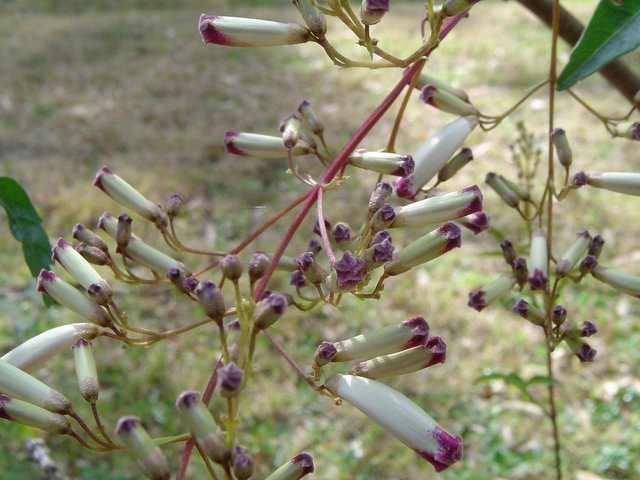
I can't remember the name of these plants so
I'll have to come back at a later date at pop it in.
I must be having a senior moment. Very irritating!
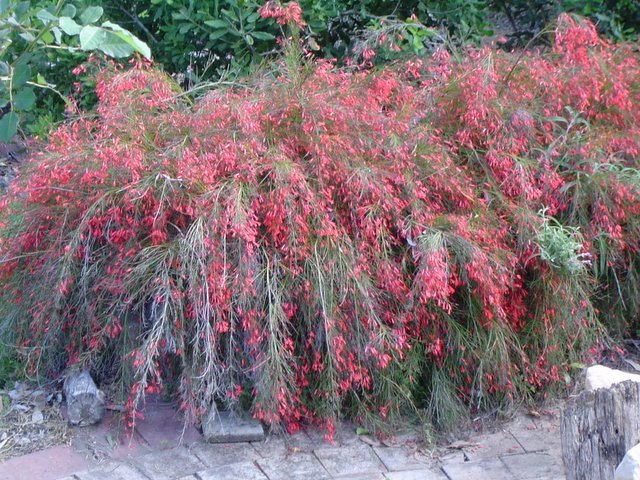
They flower like crazy after heavy rain and the nectar feeding birds love them. The Eastern Spinebills spend hours hovering over the flowers. I didn't realise that they could hover almost like hummingbirds but they can! It's interesting what you notice when you really pay attention.
Last year we had Superb Fairy Wrens nesting amongst the leaves because it is a thicket in there. Frank's Mum had a bit of fright as she was walking along and something "flew" at her. She was relieved and excited to find it was a baby wren practising flight. Posted by Picasa

Pawlonia and water iris


Flowering now - Pawlonia and yellow water iris. These irises are always the first to flower but they are extremely vigorous and so we are continually weeding them from the dam. We have tried to remove them completely but so far haven't succeeded. They are beautiful though. Posted by Picasa

17 September 2006

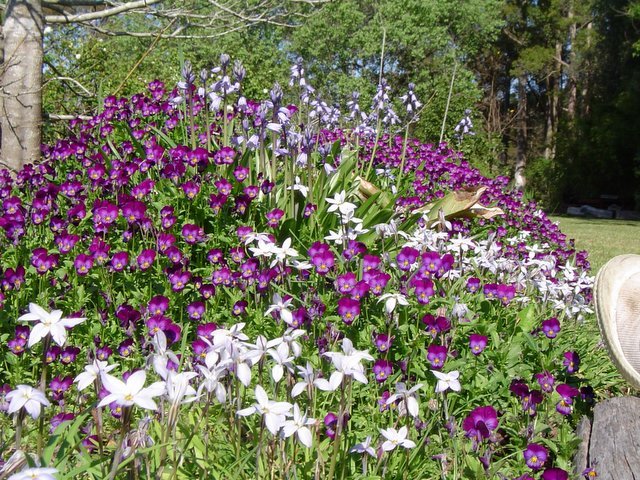
Scilla, Heartsease and Tritelia

I mentioned these three flowers a week or so ago and they are still looking lovely. Pictures don't quite do them justice. They reliably come up year after year, but this year they are spectacular. Cow manure works its magic again.

I have been working so hard in the garden over the weekend just trying to fill up any bare gaps to squeeze out the weeds - sounds simple but it isn't. This little combination has worked well and the vincas are looking very pretty in another section but there are still bare areas. Posted by Picasa

15 September 2006

Dendrobium speciosum

Otherwise known as Australian Rock Lilies. Here's another plant that has looked very sad and sorry for itself these past two years but give it a couple of heavy showers of rain and it outdoes itself putting on new clothes. Not only are these beautiful to look at but they smell very nice too.

I've had this specimen for 25 years and my father grew it before me, proving they are very slow growing. We have it mounted on a large old tree root with summer shade and winter sun. Every year I think about moving it so that it has more sunlight in summer but so far I just haven't managed to do it. This year it has 20 flower stalks. Posted by Picasa

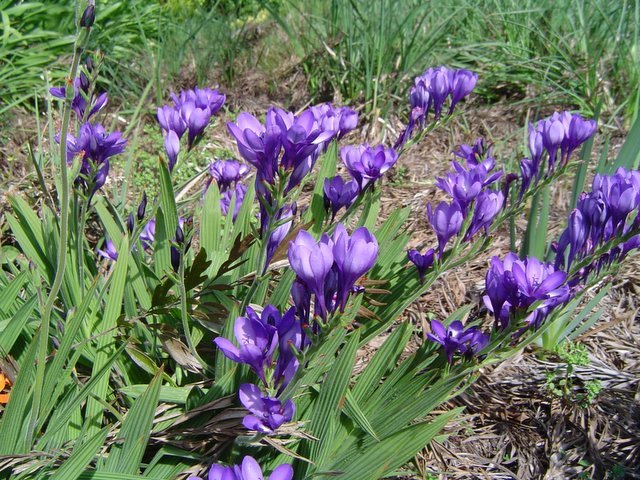
Babiana

These beautiful little bulbs are perfect for the warmer climate where many bulbs will only last the one season. These were given to me by a lovely man I met at a Garden Club many years ago. Just as some pets are said to resemble their owners this lovely little round man was known affectionately to all and sundry as the teapot man.
He definitely did have an affinity with his namesakes because he collected teapots and judged teapot competitions. He was a generous soul, always willing to share his knowledge and his plants. If you admired something in his garden you would most times find yourself with a package as you left containing the the treasures.
It was in such a way that I gained my first Babiana bulbs. You're not forgotten Bob Wilmott. Posted by Picasa

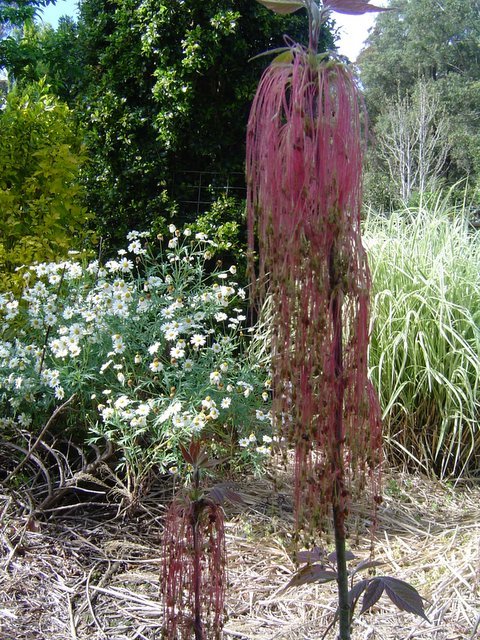
Acer negundo 'Violaceum'

I've grown a couple of Acer Negundos, commonly known as box elders, over the years because I found when choosing trees they had all the desirable characteristics I was looking for. First and foremost they had to be tough. Box Elders are almost unkillable; and the second was that they could tolerate having 'wet feet'. There are many trees regarded as very tough, but few like having their roots in cold wet soil, which is what happens here every winter (except the last two when there was no rain at all)!
Sadly Box Elders self sew and are generally regarded now as a weed with potential devastating consequences if allowed to spread willy nilly.
In the place of the baddies I have planted this beauty. Still a Box Elder but with beautiful violet flowers which are sterile. The plant went in last year and has grown quite well without any extra water, and is now putting on quite a respectable show of flowers. Posted by Picasa

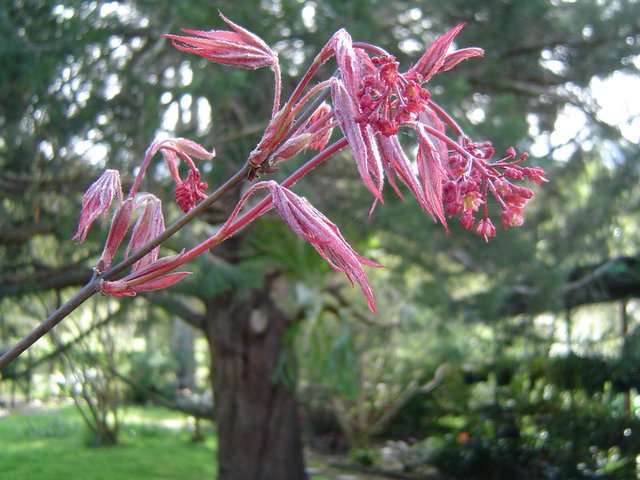
Acer palmatum 'Atropurpureum'

Spring is the time when plants go berserk with flowering, as we know. Here though is the tiny delicate flower of one of the Japanese maples. You have to be really paying attention to see these in the garden because they come and go very quickly, just a couple of days really - plus they really are very tiny.

Anyway we don't grow maples for their flowers do we - the main show is in the leaves. Posted by Picasa

10 September 2006

Blossom Time!

It's raining! Yayyyy! The tanks have been full for some days now, the dams have joined the party and the creek is running. Oh Frabjous Day!
It's wonderful to be so excited by rain. It's still pouring down as I write (truth be told it could stop now for a week or two and I would be happy), but mustn't grumble. Posted by Picasa

9 September 2006

Syzgium 'Pink Cascade'

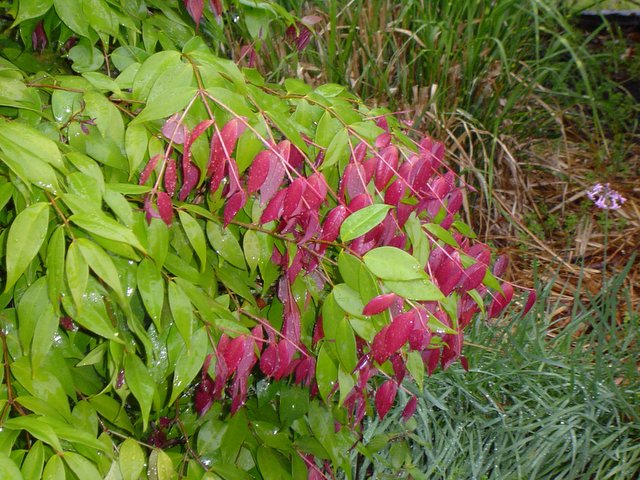
Colour in the garden doesn't just come from flowers. These pink leaves are appearing after the rain all over my beautiful weeping Syzgium. The bushes also have clusters off red/pink flowers, but I have to choose whether to have flush after flush of pink leaves or one lot of pink flowers. It seems I can't have both. Cutting off the new growth forces pink re-growth a month or so later, but also limits flowering.
What to do? At the moment I am regularly cutting back the leaves but as a kind of compromise I've planted three of these and one I leave alone, so that one flowers for me. Posted by Picasa

7 September 2006

Lorraine Lee - Alister Clark Australian bred rose

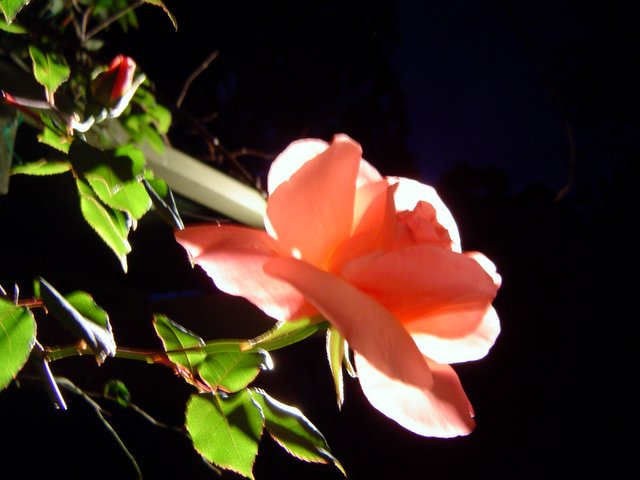
I love roses, but to grow them successfully I have to continually outwit wallabies, kangaroos and possums. I have had to resort to fences, so my garden sees my rose bushes imprisoned in a variety of gaol-like beds. If I don't lock them away the Eastern Grey kangaroos would feast each night on their new shoots until the roses give up and die.

Rosa Lorraine Lee is a beauty. Tough and prickly she is a climber who reaches up and away from the roos only to place herself just where the possums can have a nightly picnic, safe from predators.

This gorgeous colour contrasts brilliantly with my house. It used to be painted a safe pale green but now is a vivid bright blue. Strictly speaking only 3/4 of it has changed colour - I'm still working on the rest.

The blue absolutely makes my heart zing. Posted by Picasa

Good old standby

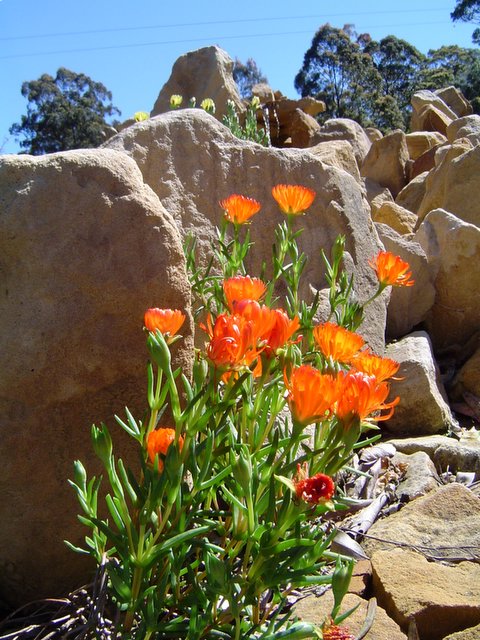
Pigface (Mesembryanthemum)are fantastic plants which survive just about whatever the weather throws at them. They grow easily from little pieces and flamboyantly flaunt themselves very early in spring.

In my garden at the moment I have patches of orange here and there, contrasting beautifully with white blossoms of all sorts. Mostly double flowering peaches (Prunus), May bushes (Spirea) and Magnolia Stellata but also the native Clematis (Clematis aristata) and Wonga Wonga vine, (Pandorea pandorana). Patches of purple pop up here and there as the violets (Viola family) finish off, together with the purply blue of Tritelias together with Johnny Jump Ups, also known as Heartsease.

The combination of Tritelias with Heartsease is stunning by the way. I always make notes (mostly mentally) I'm not really organised enough to walk around with pencil and paper, though I should be. And my mental note says to plant lots and lots of the above combination underneath all the deciduous trees because I will be well rewarded. Must spread more orange about too.
The list of jobs to do is so long! Posted by Picasa

26 August 2006

Lastly today is this tiny little blossom. It's self sewn, about 4 years old and flowering for the first time this year. The tree is now about 2 metres tall and the flowers are tiny, tiny, tiny.

Pretty though. What kind of fruit is it? I don't know. But that's part of the fun of gardening sometimes. You let things grow where they will and give them a chance to shine - if they don't out they come. This one will probably stay around for a while, there is that touch of desirable pink after all! Posted by Picasa
What a little stunner this is. A Dendrobium kingianum, but which one I don't know. I've had this plant for many years growing in a pot. I decided a couple of years ago to release all my orchids into the garden. This one I put on top of the soil between two large old logs which I then filled with leaf mulch. It's actually growing underneath one of the lovely pink blossom trees from a month back.

This year it really looks likes its appreciating my efforts on its behalf. This flower stem is completely out and there are probably another 4 or 5 stems to come - which should stretch the flowering season out enormously. I sprinkle a little cow manure on it occasionally and that's it. Posted by Picasa
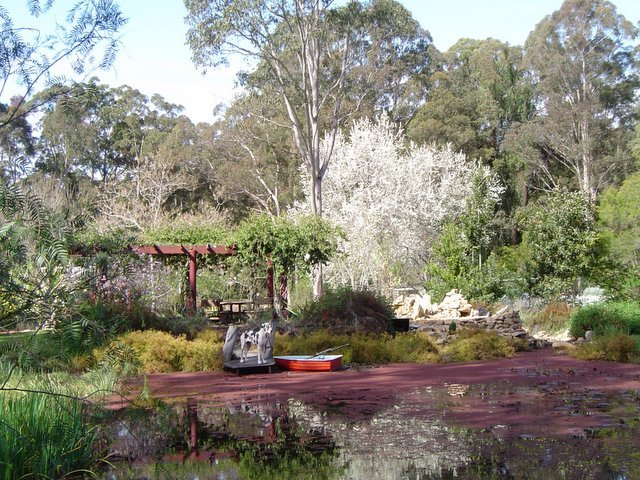
The promised white blossom following the gorgeous pink has arrived! Two very large old pear trees add their beauty to our garden. Ruby is on the jetty - she's pretty gorgeous too. She loves gardening, especially if I can spend the time to chase her all over the grass. Actually it is a pretty good game because all you have to do is stand in the middle of the lawn, she runs around you, you making little feinting moves in her direction, and she runs madly away. Uses up oodles of energy for her and none for you! And as I am already tired from lugging around hundreds of bags of cow manure and mulch I need the energy saving part of the game. Posted by Picasa

13 August 2006

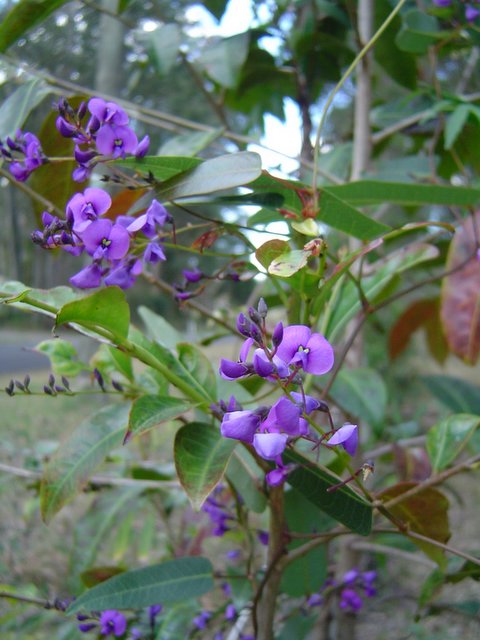
Another native flowering at the moment is Hardenbergia violacea. I am rather puzzled as to why the kangaroos don't eat this one, which is growing naturally in our bush, but they have eaten the ones which I bought from the nursery and planted in my garden! Why? My poor little bought ones can't manage to keep any new leaves on their skeltonised frames. As they valiantly try to put out each new leaf it is eaten over night. The only evidence a pile of little kangaroo poos, just to show everything digested nicely thank you very much.

My darling husband pointed out the resemblance of each flower to the cartoon character from our childhood, Yosemite Sam, big hat, cross eyed look and huge moustache. Look at a close up of the flower and you will see what he means. Posted by Picasa
Here we are still in winter, although many plants are beginning to bloom. This is a native beauty known as the Wonga Wonga Vine, real name Pandorea pandorana. Its tiny little flowers are charming and as it gently entwines itself through shrubs and over wire fences it looks very pretty indeed. Posted by Picasa
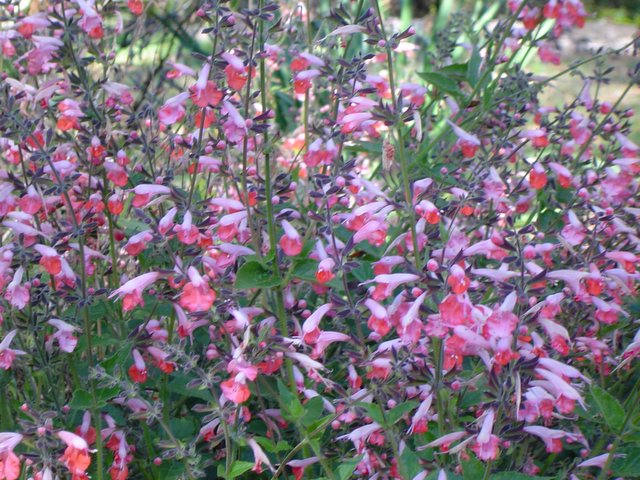
This is a dear little Salvia. I think one of the Salvia Greggii but I am not absolutely sure. It appeared on the edge of my garden one day about ten years ago; a poor straggling little thing it was. I took pity on it because I liked the colour and it has rewarded me ever since by slowly multiplying. It sailed through the drought and now has two beautiful patches of colour about 2 metres square. It seems to flower all year round and when the plants get a little straggly or when I want to grow some more I simply cut off old flower heads and sprinkle them in the new spot. Up they come and flower very quickly. How simple is that!! They are easy to keep in check and don't spread where I don't want them too. I never have to water them and look at just how beautiful they are. Posted by Picasa

4 August 2006

Half way through winter and this is what you see. Double pink peaches flowering away - makes for a happy me, (pink being my favourite colour), and very happy bees also.
As the pink blossoms are finishing the white double peaches start, and then the pear trees. It will be interesting to see if everything blossoms madly in an effort to reproduce. Certainly the autumn colour was much more intense with the dry weather. Maybe the blossom trees will be trying extra hard too?

Spring is so brief here. Technically it is not yet spring of course, but when it officially starts the weather suddenly warms up, everything comes out and then finishes, almost before you have time to enjoy it.

When we lived in Canada I was able to watch each new blossom appear in a long succession, whereas here it happens almost overnight and then just as quickly they're gone until next year.

Still there are some lovely flowering trees to look forward too. Posted by Picasa

23 July 2006

The Archontophoenix cunninghamiana (Bangalow Palms)
have colonised a clearing which appeared a year or two ago when one of the older trees fell over.

I don't like these planted into gardens. They really need to be surrounded by rain forest to look good to me. Posted by Picasa
The fallen logs look fantastic covered in green. Posted by Picasa