I thought I better do a little housekeeping and name a few things on this site. I posted a photo long ago of a fly, and didn't know what is was. Here it is again.
This time I know it is a Robber Fly, family Asilidae. One site told me there are 7,100 members of this family!! That being the case I will be happy for the present just to know it is a Robber Fly.
I have been doing lots of research on flies and bugs lately, and all on the internet. This information is only available because of the generosity of other people. They post photos and all sorts of things for people like me to learn stuff.
And I thank them.
In my initial post I said I was amazed at how quickly this fly sped away once it had made up its mind to do so. It just took off straight up like a helicopter and was gone. Apparently one of the characteristics of this fly is their speed of flight. Also their sturdy appearance. I guess you have to be tough and strong if you are going to eat other insects.
One site I found where all the members are keen on Diptera (flies to the rest of us) is
Link
Another interesting bug site, again just people helping out other people is
Link.I like this one because of all the photographs. Really beautiful, except in the section labelled "Carnage" where people have killed the bug before finding out what it was.
9 February 2007
Robber Fly
5 February 2007
Insects

I am still having fun with my new camera and capturing all sorts of things which I had no hope of seeing before. There's a whole tiny world out there if we just look hard enough.
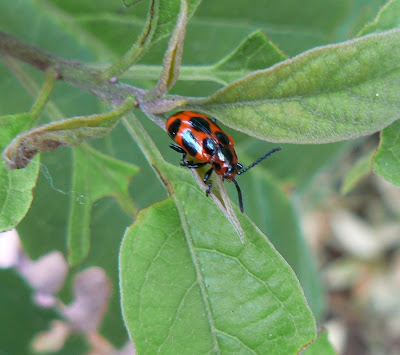
This is quite a tiny beetle, think ladybird size. Although when you see her you know she is not a ladybird, not with that shape. Ladybirds always make me think of the VW beetle, same little rounded shape, but I don't suppose I'm the first one to have had that thought. They are called VW Beetles after all.
The tell tale holes in the leaves gives a clue about the diet of this pretty beetle. I have been reliably informed she is a Leaf Eating Beetle but other than that I cannot name her.
Next up is a very small fly. I tried the obvious in the search engines "green and black banded fly" but that didn't work. It could have. After all if you type in "pink-bellied moth" it works - you get a hit. Maybe it isn't even a fly - I'm just assuming, but the more I look at her the more I think she looks mosquitoish, especially with those long legs.
She was really, really tiny, even minute, but I can't remember what type of leaf it was on. Drat. Now I am going to have to walk around with a notebook, or maybe better still a little tape recorder.
At least now I have a record of what I've seen - I don't have to try and remember while being confronted with lots of possibilities, which by the time I have looked at them all I have no hope of even remembering what the original insect looked like. It's been wiped from my brain.
I didn't fare any better with this metallic blue fly.
While I was searching I came across a website though which is really interesting. It seems to be one family's effort to study insects in their native area, (Brisbane, Australia) and their efforts are really impressive and scholarly.
Link
Here we have a very well camoflauged insect which I first took to be a moth. I had my doubts though because I thought I could see bug eyes, rather than antennae. It took me a while of searching through various books and in the end I found it quite by accident. It is in fact a Scolypopa australis or Passionvine Hopper and it is indeed a type of bug which sucks fluids from plants.
A book I really like is Burnum Burnum's Wild Things which is a pocket sized book that you can take bushwalking with you. Its contents are organised in an unusual way, for example flowers are listed under their colour, so that if you come across a pink flower you just look in the pink/red flower section. By necessity it only has quite common things in it but nevertheless very useful.
Lastly is this little beetle, classic lady bird shape. There is a family of them living on my Zucchini plants. I have no idea if they are good guys or bad guys but I can't see any apparent damage so they are safe for the moment. Besides I have so many zucchinis I can share.
4 February 2007
Caryopteris x clandonensis 'Worcester Gold'
I don't have as many flowers as I would like for the time of year, but I do have a few. This is a new plant of mine, bought from East Coast Perennials, New South Wales, a mail order nursery. I buy lots of plants mail order because the nurseries nearby have boring stuff and I like to hunt up more unusual plants.
I had a very harsh area of the garden which I wanted to plant with yellow and orange coloured plants to match a structure which I had built to house a lovely old cart. The Carriage House we call it. And the garden hugging its edges is by necessity "The Carriage House Garden".
I ordered this particular plant because I was promised yellow foliage when it first comes back to life after its rest in winter, however I neglected to read the rest of the catalogue entry apparently -which said mauve flowers! Definitely the wrong colour for that area.
It won't be a problem though because this plant self sows and I am sure I can move the seedlings to a more suitable place early next spring. Meanwhile it is certainly deserving of a place in the garden.
Brugmansia x Candida or Angel's Trumpets
Could anything be more gorgeous?
I feel so lucky to have these flowers this year because the rainfall has been so low and I have noticed that they like lots of moisture, though they survive without it. When we have lots of rain they have flush after flush of flowers all summer long, and even well into autumn some years.
We had a reasonable fall of rain a few weeks back and this was the result.
I love to go for evening walks, right on dusk, just to smell my Angel's Trumpets.
